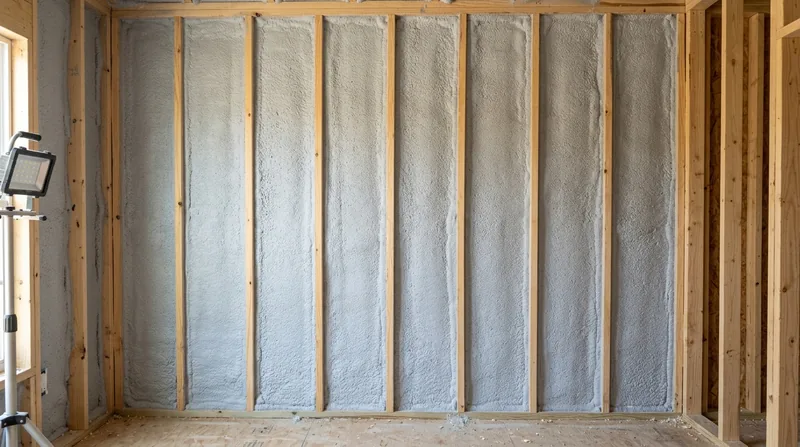




Open cell spray foam insulation in Jackson seals the air leaks and moisture pathways that plague homes across Hinds and Rankin counties. Jackson sits in IECC climate zone 3A, hot and humid nearly year-round, where vented attics and crawl spaces pull in damp outside air and drive energy bills higher than they should be. Older homes in Belhaven and Fondren, mid-century ranches scattered throughout the metro, and newer builds around Ridgeland and Brandon all benefit from open cell foam's ability to expand into stud bays and seal out the humidity that builds up inside walls and rafter cavities. Unlike closed cell foam, which hardens to a dense, rigid shell, open cell expands and breathes, making it the right choice for interior walls and attic rafters where moisture control and sound dampening matter as much as insulation value. We work with written estimates that specify R-value and foam thickness so you know exactly what you are getting.
Why Open Cell Spray Foam Works in Jackson's Hot, Humid Climate
Jackson's climate drives moisture inward through the building envelope for most of the year. Vented attics and crawl spaces remain the standard in the older housing stock, and they pull in humid outside air that condenses on wood framing and insulation alike. Open cell foam stops that infiltration at the source, sealing the air gaps that fiberglass batts and blown-in cellulose leave behind. It also allows moisture vapor to move through the foam itself, reducing the risk of trapped moisture and decay in the wood structure beneath.
- Expands to fill stud bays and rafter cavities without leaving gaps or voids.
- Allows moisture vapor to pass through the foam, reducing condensation risk in Jackson's humid climate.
- Provides sound dampening in interior walls and attic spaces, a benefit closed cell foam does not match.
- Costs less per board foot than closed cell foam, making it the price-conscious choice for attic work on sound structures.
- Works well in new construction around Ridgeland and Brandon where interior walls and attic framing are still exposed.
Open cell foam is not the answer for every job, but it is the right one when air sealing and moisture control matter more than the highest possible R-value per inch.
Key info: A mid-century ranch in Jackson with an original vented attic and fiberglass batts loses conditioned air through gaps in the insulation and through rim joists where the walls meet the foundation. Open cell foam seals those leaks and stops the humidity from driving inward, cutting the load on your air conditioning system and protecting the wood structure year-round.
For more detail on how foam insulation compares to other methods, see our guide to closed cell spray foam insulation, which offers a different set of trade-offs for applications where vapor control and highest R-value are the priorities.
How We Install Open Cell Spray Foam in Jackson Homes and Buildings
Open cell foam installation begins with a site visit to assess the existing insulation, air leaks, and moisture conditions. We inspect attic framing, wall cavities, and rim joists to determine whether the substrate is sound and dry. If moisture or contamination is present, we address it first or recommend that you do so before we spray. Once the site is ready, we set up mechanical ventilation to manage off-gassing during and after the application, protecting occupants and crew alike.
- We inspect the attic or wall cavity and identify any existing insulation, air leaks, or moisture that must be cleared before foam is applied.
- We set up mechanical ventilation during application and for the full curing window, typically twenty-four to forty-eight hours.
- We spray open cell foam in controlled passes, building thickness to the specification in your estimate and maintaining proper drum temperature and chemical ratio.
- We trim excess foam and install thermal barriers (typically drywall) where code requires them, which depends on your address and local building department rules.
- We provide written documentation of the work completed, including the R-value and thickness installed, so you have proof for your records and for any future buyer or inspector.
The entire process is straightforward when done right, and the biggest difference between a professional installation and a poor one is the attention to ventilation, thickness control, and re-entry timing.
Example: A homeowner in Madison calls with a new construction attic framing job. The rafter bays are open and ready to be sealed. We schedule a visit, confirm the substrate is dry, set up ventilation, spray the open cell foam to the thickness specified in the estimate (typically three to five inches for R-13 to R-21), and allow the full cure window before the drywall crew comes in. The homeowner has a sealed attic with documented R-value and no surprises on move-in day.
Learn more about how we handle attic spray foam insulation and the role of proper ventilation and air sealing in the larger strategy.
Open Cell Spray Foam Installation Methods
| Approach | Description | Best for |
|---|---|---|
| Open cell in attic rafters | Spray foam applied to the underside of roof decking to create a sealed, conditioned attic. | New construction and retrofit projects where the attic will be used as living or storage space. |
| Open cell in interior wall cavities | Foam sprayed into stud bays from the interior, filling gaps and sealing air leaks without requiring exterior demolition. | Retrofit work in older homes where exterior walls are already finished and interior access is available. |
| Open cell as a top-up layer | Applied over existing fiberglass or mineral wool to fill voids and seal air gaps without removing the old insulation. | Attics with sound but incomplete insulation where adding R-value and sealing gaps is more cost-effective than full removal. |
| Open cell in rim and band joists | Foam sprayed into the rim cavity where the wall band meets the foundation sill, sealing a major air leak path. | Foundation-level air sealing in crawl space and basement areas to reduce infiltration and moisture entry. |
Open Cell Spray Foam Insulation Cost in Jackson: What to Expect
Open cell spray foam typically starts at around $0.55 per board foot in the Jackson market, though the final price depends on several factors specific to your project. Attic jobs in older homes near Belhaven or Fondren may involve removing old insulation before foam is applied, which adds labor and disposal cost. Newer construction around Ridgeland and Brandon with open rafter bays and clear access runs faster and costs less per board foot. Wall cavities in mid-century ranches require careful setup to avoid over-pressurizing stud bays, and rim joist work at the foundation involves smaller square footage but the same crew setup cost.
- Board footage is the primary driver: a typical attic retrofit in Jackson ranges from 800 to 2,500 board feet depending on attic size and depth.
- Existing insulation removal adds labor and disposal fees, but is often worth the cost to avoid trapping moisture under new foam.
- Access and safety setup (scaffolding, ventilation, containment) increase cost on complex or confined jobs.
- Thermal barrier installation (drywall or intumescent paint) is required by code in some jurisdictions and adds material and labor.
- Travel is included in our service area covering Jackson, Richland, Pearl, Clinton, Ridgeland, Flowood, and surrounding counties.
The best way to understand cost for your specific project is to request a free estimate with written R-value and thickness specifications. We also recommend getting two or three estimates from contractors you can verify, so you can compare not just price but the scope of work and credentials behind each bid.
Ballpark example: A 1,500 square foot attic in Jackson with existing fiberglass batts and a goal of R-30 sealed insulation typically runs between $2,500 and $4,500 depending on attic height, roof complexity, and whether old insulation is removed first. A smaller rim joist job, perhaps 200 board feet, might cost $150 to $300. Always ask for the thickness and R-value in writing so you know what you are paying for.
For detailed pricing on various job types and sizes, visit our pricing overview.
What to Look for When Hiring a Spray Foam Insulation Contractor Near Jackson
Finding a reliable spray foam contractor in the Jackson area is easier when you know what to check. The insulation and spray foam trade includes both local independent shops with a Jackson address and local crew, and national franchises with rigs that move from job to job. The best contractors share a commitment to honest guidance: open cell versus closed cell is arbitrated by use case, not by what they have in stock, and sometimes blown-in fiberglass is the right answer for a simple top-up. Verify that any contractor you hire is fully insured, provides written estimates with R-value and thickness specifications, and can explain the thermal barrier and ventilation requirements that apply to your address.
- Confirm that the contractor is fully insured with proof of coverage available on request.
- Get written estimates from at least two contractors that specify the R-value, foam thickness, and thermal barrier requirements for your address.
- Ask about the contractor's experience with the specific application you need, whether attic, wall, crawl space, or rim joist work.
- Check references from recent jobs in Jackson, Ridgeland, Madison, or other nearby areas where you can verify the work quality.
- Confirm that the contractor understands local permitting and building code requirements for your address and will work with your local building department if permits are required.
- Ask about the ventilation plan during and after application, and the re-entry window before occupants can return to the space.
A contractor who provides a detailed estimate with no R-value or thickness, promises immediate re-entry, or offers a price far below market is signaling a lack of professionalism. The right contractor will take the time to inspect your home, answer your questions, and explain the work in writing before a crew shows up.
If you are ready to move forward, contact us for a free estimate at (601) 519-4413. We respond within 24 hours and provide written specifications with every quote.
Open Cell Spray Foam Insulation in Jackson: Pricing Guide
| Service | Price | Details |
|---|---|---|
| Open cell spray foam, attic application | Starting at $0.55/board ft | Sealed attic in new construction or retrofit; cost varies with attic size, access, and roof complexity |
| Open cell spray foam, wall cavity retrofit | Starting at $0.55/board ft | Interior wall insulation without exterior demolition; labor increases with wall height and cavity depth |
| Open cell spray foam, rim and band joist sealing | Starting at $0.55/board ft | Foundation-level air sealing; smaller square footage but same crew setup cost as larger jobs |
| Insulation removal and disposal (if required) | On estimate | Necessary before new foam in retrofit work; cost depends on attic size, material type, and debris volume |
| Travel and free estimate | Included | No separate mileage fee within Jackson metro and surrounding service areas; estimate response within 24 hours |
Indicative pricing, the exact cost depends on square footage, finish, and site access. Free personalized estimate within 24h at (601) 519-4413.


