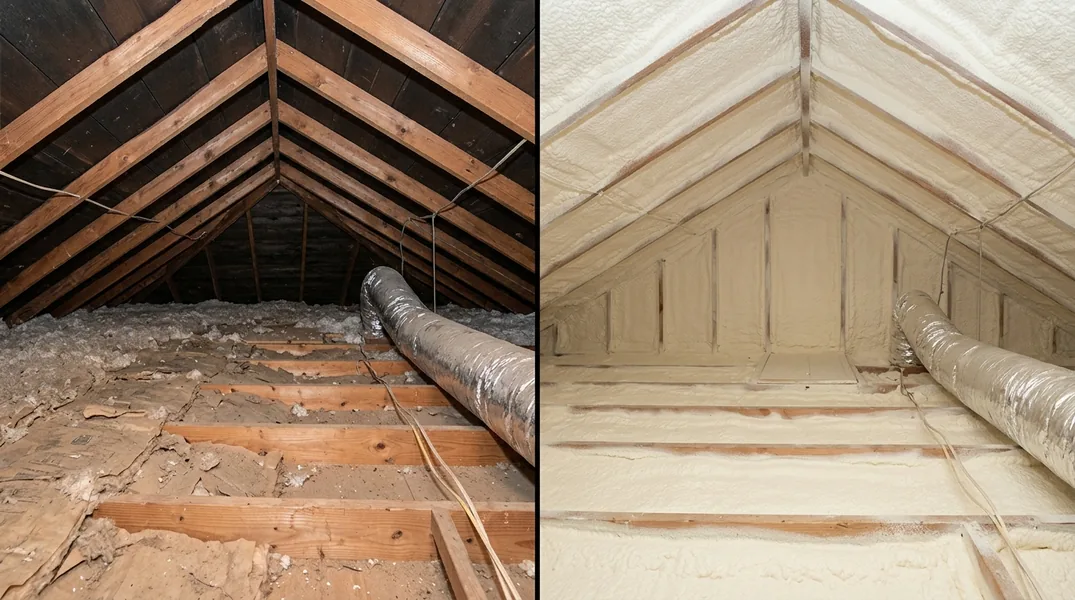
Why Mid-Century Ranches Need Attic Insulation Upgrades
Mid-century ranch homes have a timeless charm that continues to appeal to homeowners throughout Hinds and Rankin County. Built primarily between the 1940s and 1970s, these properties feature clean lines, open floor plans, and practical design that remain highly desirable today. However, one area where these classic homes often fall short is insulation. Most mid-century ranches were constructed with minimal attic insulation, if any at all, which means your heating and cooling costs are likely higher than they need to be.
The attic is where most home energy loss occurs. Without adequate insulation, conditioned air escapes through the roof during winter, and heat radiates down into your living spaces during summer. For homeowners in Jackson and surrounding areas, upgrading your attic insulation is one of the most cost-effective improvements you can make. Not only will you see immediate savings on your monthly utility bills, but you'll also improve comfort, reduce strain on your HVAC system, and increase your home's overall value. The question isn't whether to upgrade, but which insulation type will work best for your specific home.
Spray Foam vs. Blown-In Insulation: Which Performs Better?
When comparing spray foam vs. blown-in insulation, the differences come down to application method, performance, and long-term durability. Blown-in insulation, typically made from fiberglass or cellulose, is installed by blowing loose fibers into your attic space using specialized equipment. This method is relatively quick and less expensive upfront, making it an attractive option for budget-conscious homeowners. However, blown-in insulation settles over time, which means its R-value decreases and gaps can develop around obstacles like pipes, wiring, and roof rafters.
Attic Spray Foam Insulation offers superior performance in nearly every measurable way. Spray foam expands as it's applied, creating an airtight seal that conforms perfectly to irregular spaces and fills every gap. This means no air leakage, no settling, and consistent R-value performance for decades. While spray foam costs more initially, the energy savings and longevity make it a better investment over the lifetime of your home. For mid-century ranches with irregular attic layouts and existing air leaks, spray foam is often the optimal choice.
Spray Foam vs. Fiberglass: Why Fiberglass Falls Short in Attics
Fiberglass insulation has been the standard in residential construction for decades, and many homeowners are familiar with its pink batts and rolls. When comparing spray foam vs. fiberglass, it's important to understand that fiberglass works reasonably well in new construction where walls are open and easily accessible. However, in retrofit applications like upgrading an existing attic, fiberglass has significant limitations. Fiberglass batts require careful installation to maintain their R-value, and even small gaps between pieces can reduce overall performance by 10 to 15 percent.
Fiberglass also absorbs moisture, which can lead to mold growth and degradation over time, especially in humid climates like Mississippi. The material can settle, compress, and lose effectiveness as your home shifts and settles naturally. Additionally, fiberglass doesn't create an air barrier, so even if installed perfectly, air can still move around the batts through convection. Spray foam, by contrast, creates both insulation and an air barrier simultaneously, making it far more effective at controlling temperature and moisture in your attic space.
Spray Foam vs. Cellulose: Understanding the Trade-offs
Cellulose insulation is made from recycled paper products and is often marketed as an eco-friendly alternative to fiberglass and spray foam. When comparing spray foam vs. cellulose, cellulose does offer a higher R-value per inch than fiberglass, which appeals to homeowners seeking maximum efficiency in limited space. However, cellulose shares many of the same drawbacks as blown-in fiberglass. It settles significantly over time, sometimes losing up to 20 percent of its R-value within the first year. Cellulose is also highly hygroscopic, meaning it absorbs and holds moisture readily, which can create conditions for mold growth and pest activity.
Another concern with cellulose is that it requires chemical fire retardants to meet building codes, and these treatments can off-gas over time. Spray foam, particularly Closed Cell Spray Foam Insulation, provides superior moisture resistance and maintains its R-value indefinitely. While cellulose may cost less upfront, the long-term performance and durability advantages of spray foam make it the better choice for homeowners planning to stay in their homes for many years.
Best Insulation for Attic: Why Spray Foam Wins for Mid-Century Homes
Determining the best insulation for attic applications requires evaluating several factors: R-value, air sealing capability, moisture resistance, durability, and performance over time. For mid-century ranches in Richland and surrounding areas, spray foam consistently outperforms traditional options across all these criteria. Closed cell spray foam delivers an R-value of approximately 6.0 to 7.0 per inch, compared to 3.2 to 3.8 for fiberglass and 3.6 to 4.2 for cellulose. This means you need less material to achieve the same thermal resistance, which is particularly valuable in attics with height restrictions.
Beyond raw R-value, spray foam provides complete air sealing, eliminating the convective heat loss that occurs with traditional insulation. It creates a vapor barrier that prevents moisture infiltration, reducing the risk of mold and wood rot. Spray foam doesn't settle, doesn't support pest habitation, and maintains its performance for the life of your home. For homeowners serious about maximizing energy efficiency and comfort in their mid-century ranch, spray foam represents the best long-term investment. If you're ready to explore this option, contact Jackson Spray Foam Insulation at (601) 519-4413 to discuss your specific needs.
Attic Spray Foam Insulation Cost in Jackson: What to Budget
Understanding the cost of upgrading your attic insulation is essential for making an informed decision. Attic Spray Foam Insulation typically costs between $1.50 and $3.50 per board foot, depending on the type of foam (open or closed cell), your attic's size and complexity, and current market conditions. For a typical 1,500 square foot attic, you might expect to invest between $3,000 and $8,000 for spray foam, compared to $800 to $2,000 for blown-in insulation. While the initial cost difference is substantial, the energy savings and performance benefits quickly justify the investment.
Most homeowners in Jackson see payback periods of five to ten years, after which the energy savings are pure benefit. Additionally, many utility companies offer rebates for attic insulation upgrades, and some states provide for energy-efficient home improvements. To get an accurate estimate tailored to your home's specific dimensions and condition, reach out for a free estimate. Our team at Jackson Spray Foam Insulation will assess your attic, discuss your goals, and provide transparent pricing so you can make the best decision for your family and budget.
Looking for a professional spray foam insulation contractor in Jackson? Jackson Spray Foam Insulation responds fast for all your spray foam insulation needs.
Get a Free Quote